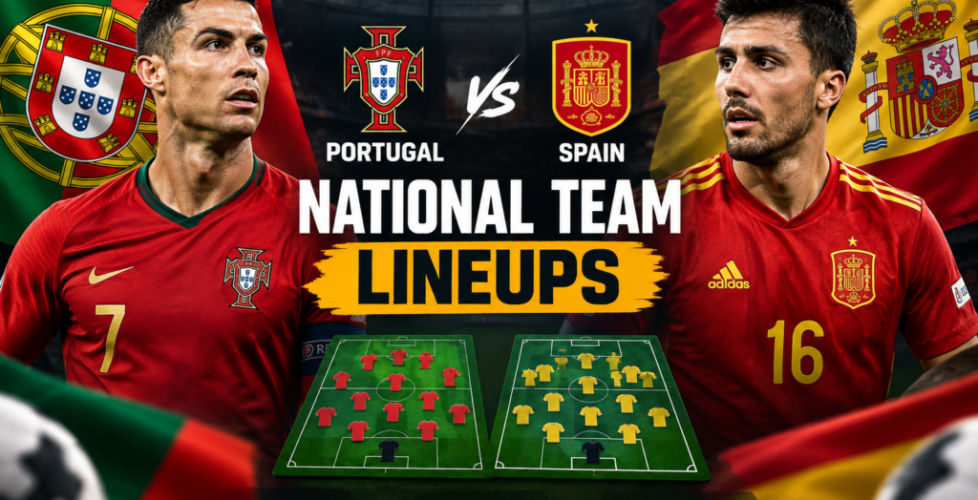
Portugal vs Spain National Team Lineups
Portugal vs Spain National Team Lineups: Full 2026 World Cup Breakdown
Portugal vs Spain national team lineups shaped one of the most-watched matches of the 2026 World Cup, and the details behind those lineups explain the result better than the scoreline does. This guide covers both starting eleven, the benches, every substitution, the key moments in order, the match statistics, the 2025 Nations League final lineups, the head-to-head record, and what happened next, including Spain’s run to the World Cup title.
Match Facts:
Every reader who searches for Portugal vs Spain national team lineups needs the basic facts first. The table below lists them in one place.
| Competition | FIFA World Cup 2026, Round of 16 |
| Date | Monday, 6 July 2026 |
| Venue | Dallas Stadium (AT&T Stadium), United States |
| Attendance | 70,649 |
| Referee | Anthony Taylor (England) |
| Result | Portugal 0-1 Spain (0-0 at half-time) |
| Goal | Mikel Merino, 90+1′ |
| Spain absences | Yeremi Pino and Nico Williams out, Víctor Muñoz a doubt |
| Portugal absences | None reported before the match |
| Next round | Spain played Belgium in the quarter-finals |
Portugal vs Spain National Team Lineups: Quick Answer
Both coaches used a 4-2-3-1 shape in the Portugal vs Spain national team lineups, so the match turned on small edges instead of tactical surprises. Spain’s coach kept the same eleven that had started against Austria in the Round of 32. Portugal’s coach picked João Félix over Rafael Leão in the attacking line, even though some previews expected Leão.
| Position | Portugal | Spain |
| Goalkeeper | Diogo Costa | Unai Simón |
| Midfield pair | Vitinha, João Neves | Rodri, Pedri |
| Attacking trio | Pedro Neto, Bruno Fernandes, João Félix | Álex Baena, Dani Olmo, Lamine Yamal |
| Striker | Cristiano Ronaldo | Mikel Oyarzabal |
| Shape | 4-2-3-1 | 4-2-3-1 |
Portugal (4-2-3-1)Spain (4-2-3-1)RonaldoJ. FélixB. FernandesP. NetoVitinhaJ. NevesN. MendesVeigaR. DiasCanceloD. CostaOyarzabalBaenaOlmoYamalPedriRodriCucurellaLaporteCubarsíPorroU. Simón.
How Both Teams Reached the Round of 16
The Portugal vs Spain national team lineups make more sense when you know how each team arrived. Portugal’s route was uneven, and Spain’s route started badly before it improved sharply.
| Stage | Portugal | Spain |
| Group match 1 | 1-1 vs DR Congo | 0-0 vs Cape Verde |
| Group match 2 | 5-0 vs Uzbekistan | 4-0 vs Saudi Arabia |
| Group match 3 | 0-0 vs Colombia | 1-0 vs Uruguay |
| Round of 32 | 2-1 vs Croatia | 3-0 vs Austria |
Portugal needed a late rescue against Croatia. Ivan Perišić gave Croatia the lead, Cristiano Ronaldo equalised from the penalty spot, and Gonçalo Ramos scored a 94th-minute winner after coming on for Ronaldo. Spain opened with a goalless draw against tournament debutants Cape Verde, then scored eight goals across their next three games. Against Austria, Mikel Oyarzabal scored twice and Pedro Porro added a header. That contrast made Spain the clear favourite, and betting odds priced Portugal as the underdog.
Portugal’s Starting XI Explained, Player by Player
Roberto Martínez built a balanced side around Ronaldo’s finishing, Bruno Fernandes’ passing, and a two-man midfield pivot. Here is how each unit worked.
Goalkeeper: Diogo Costa
Costa started his tenth World Cup match for Portugal across the 2022 and 2026 tournaments. He stopped Mikel Oyarzabal’s early effort, the first shot on target of the game, and he later touched Lamine Yamal’s free-kick over the crossbar. Costa gave Portugal a steady base, and only a well-worked move beat him at the end.
Defence: Cancelo, Dias, Veiga, and Mendes
The back four featured Nuno Mendes, Renato Veiga, Rúben Dias, and João Cancelo. Dias led the line, while Veiga, Cancelo, and Mendes gave Portugal comfort on the ball. Mendes did the most notable work. He nullified Yamal for 55 minutes and hit the crossbar with a deflected drive. An injury then forced him off in the 56th minute, which removed Portugal’s best answer to Spain’s most dangerous attacker.
Midfield: Vitinha and João Neves
Their job was to slow Spain’s rhythm and feed the attacking trio between the lines. Both prefer short passing, so Portugal matched Spain’s style instead of trying to disrupt it. That approach limited Spain’s central chances, but it also cost Portugal possession, which finished at 44%.
Attack: Neto, Fernandes, Félix, and Ronaldo
Some previews listed Rafael Leão in this line, but the confirmed team named Félix, and one publication corrected its earlier version to reflect that. The choice signalled that Martínez wanted combination play between the lines first and pace second. Leão entered at 71 minutes to stretch a tiring Spanish back four.
Ronaldo led the attack at 41 years old. He finished the tournament with three goals in five matches, and the match report from Olympics.com framed the game as his final World Cup appearance. He also holds Portugal’s record for World Cup appearances, with 27 matches across six tournaments from 2006 to 2026.
Spain’s Starting XI Explained, Player by Player
Luis de la Fuente trusted a settled group, and that trust paid off. Spain’s eleven started with the same names that had dismantled Austria in the previous round.
Goalkeeper: Unai Simón
Simón faced a few tests, but he stopped Ronaldo’s instinctive volley after good work from Félix. That save mattered because Ronaldo’s volley was Portugal’s clearest first-half chance.
Defence: Porro, Cubarsi, Laporte, and Cucurella
Pedro Porro, Pau Cubarsí, Aymeric Laporte, and Marc Cucurella formed the back four. Cubarsí, 19, and Laporte, an experienced international, limited Ronaldo’s touches in dangerous areas. Sky Sports noted that Ronaldo was the only Portugal player to land a shot on target, which shows how well Spain’s defenders limited the rest of the attack. Porro and Cucurella supported the build-up but rarely left their partners exposed.
Midfield: Rodri and Pedri
Rodri protected the defence and set the tempo, while Pedri linked the midfield to the front line. Together they explain Spain’s 56% possession. Rodri also delivered the pass that started the winning move, and he later lifted the World Cup trophy after the final.
Attack: Baena, Olmo, Yamal, and Oyarzabal
Álex Baena kept his place on the wing because Nico Williams was injured. Dani Olmo played behind the striker, and Lamine Yamal, then 19, carried the biggest threat. Mikel Oyarzabal led the line and was Spain’s top scorer at the tournament by the time of the final. Oyarzabal forced the first save of the match, but he also missed a clear chance late on after Olmo put him through, when he appeared to think he was offside.
Team News for the Portugal vs Spain National Team Lineups: Absences and Benches
Injuries shaped the Portugal vs Spain national team lineups before kick-off. Spain’s pre-match list of absentees included Yeremi Pino and Nico Williams, with Víctor Muñoz a doubt. Portugal reported no absences. That difference mattered on the wing, because Baena started in place of Williams and Yamal took on more responsibility as Spain’s main creative outlet.
Portugal’s bench held plenty of quality. The listed substitutes included Gonçalo Ramos, Gonçalo Guedes, Francisco Conceição, Rafael Leão, Francisco Trincão, Bernardo Silva, Samú, Rúben Neves, Gonçalo Inácio, Tomás Araújo, Matheus Nunes, Diogo Dalot, Nélson Semedo, Rui Silva, and José Sá. Martínez used five of them: Semedo, Dalot, Leão, Conceição, and Bernardo Silva. Ramos, who had scored the winner against Croatia, did not appear in the recorded substitutions. Spain used four substitutes: Ferran Torres, Mikel Merino, Fabián Ruiz, and Borja Iglesias.
Formations and Tactical Duels Inside the Portugal vs Spain National Team Lineups
When both teams use the same shape, every player meets a direct opponent. That structure created four clear duels, and each one helps explain why the game stayed level for so long.
Midfield control: Rodri and Pedri against Vitinha and Neves
Both pairs preferred to keep the ball, so neither side gained easy control. Rodri’s positioning shielded Spain’s back line, while Vitinha’s passing range gave Portugal a way to break lines. The two-versus-two contest produced few clear chances, which explains the goalless first half.
Yamal against Portugal’s defenders
Yamal creates danger by isolating a defender and forcing a decision. Mendes handled that task well until he left the pitch. After his replacement Semedo came on, Yamal escaped him more easily, and that led to a low Baena shot that Costa saved.
Ronaldo against Cubarsí and Laporte
A 41-year-old striker relies on timing, not speed. Cubarsí reads danger early and steps into passing lanes, and Laporte’s experience beside him removed the aerial threat. Spain kept Ronaldo away from the ball for long stretches, which starved Portugal’s attack of its main finishing point.
Spain’s defensive structure
Spain’s control and compact defending shaped the game. Sky Sports reported that Spain became the first team in World Cup history to register six successive clean sheets. That record shows why Portugal struggled to create clear chances even with a strong attacking line.
Portugal’s plan was cautious. ESPN’s report noted that Portugal paid the price for playing too cagey in the second half. That caution held Spain off for most of the match, but it also handed Spain’s bench the chance to decide the result.
Minute-by-Minute: Every Key Moment From Portugal vs Spain
The match followed a clear pattern. Spain controlled territory, Portugal defended in numbers, and the game exploded only at the end. The timeline below shows when each major change or chance arrived.
3′ Oyarzabal forces saveHT 0-071′ Dalot, Leão on75′ F. Torres on56′ Mendes off, Semedo on83′ Conceição, B. Silva on85′ Merino, F. Ruiz on90+1′ Merino scoresPortugal eventSpain event.
First half: Spain probe, Portugal counter, 0-0
Portugal started the game in a compact shape, and Spain answered quickly. In the third minute, Mikel Oyarzabal forced Diogo Costa into the first save of the match. Spain kept pushing through Lamine Yamal and Álex Baena, but Costa reacted well each time.
Portugal’s best first-half chance fell to Cristiano Ronaldo. João Félix worked the ball well, and Ronaldo tried an instinctive volley that Unai Simón kept out. Soon after, Nuno Mendes struck a stinging drive from a short corner routine. The ball deflected off Pedro Porro’s head and hit the crossbar. The teams went in at 0-0, and neither goalkeeper had faced sustained pressure.
Second half: injury, adjustments, and a tense stalemate
The second half started with a blow for Portugal. An injury forced Mendes off in the 56th minute, and Nélson Semedo replaced him. Yamal then escaped his new marker, which led to a low Baena shot that Costa saved easily. Yamal also whipped in a free-kick that Costa touched over the bar. Bruno Fernandes answered with a strike that hit the side-netting.
The game then slowed into a stalemate. Both teams made changes, and the pace dropped. ESPN’s report described one more Spain chance: Oyarzabal ran clear after a pass from Dani Olmo with eight minutes left, but he dragged his effort away after appearing to think he was offside. Portugal responded with a late push, and Bernardo Silva headed narrowly over from Francisco Conceição’s cross.
Stoppage time: Torres and Merino decide it
Then the match turned. Rodri passed to Ferran Torres, who cleverly slipped in Mikel Merino. Merino took his time and slotted into the bottom-left corner past Costa. Both scorer and creator had come on as substitutes, and Merino had replaced Olmo only six minutes earlier. Portugal had no time to reply, and two late yellow cards showed how frayed the team had become. Sky Sports noted that the goal lifted the tournament’s tally of last-minute winners to ten, the most in a single World Cup edition. ESPN reported that Ronaldo’s World Cup dream ended in tears.
Match Statistics: Portugal vs Spain National Team Lineups by the Numbers
The numbers confirm what the eye test suggested about the Portugal vs Spain national team lineups. Spain controlled the ball and created more chances, while Portugal defended in a compact block and hoped to strike on the break.
| Statistic | Portugal | Spain |
| Possession | 44% | 56% |
| Total shots | 10 | 15 |
| Expected goals (xG) | 0.60 | 1.77 |
| Corners | 3 | 7 |
| Fouls committed | 9 | 13 |
| Yellow cards | 2 | 1 |
| Substitutions used | 5 | 4 |
The xG gap is the most telling figure. Portugal recorded 0.60 expected goals to Spain’s 1.77, which means Spain created roughly three times the quality of chances. Spain also forced more corners and kept Portugal’s forwards away from the box for long spells. Portugal’s low foul count shows disciplined defending, but two late yellow cards suggest the team tired in the final minutes.
Substitutions That Reshaped the Portugal vs Spain National Team Lineups
Both benches played a role, but Spain’s changes carried the decisive impact. The table lists every change in order.
| Minute | Team | Off | On |
| 56′ | Portugal | Nuno Mendes (injury) | Nélson Semedo |
| 71′ | Portugal | João Cancelo | Diogo Dalot |
| 71′ | Portugal | João Félix | Rafael Leão |
| 75′ | Spain | Álex Baena | Ferran Torres |
| 83′ | Portugal | Pedro Neto | Francisco Conceição |
| 83′ | Portugal | Vitinha | Bernardo Silva |
| 85′ | Spain | Dani Olmo | Mikel Merino |
| 85′ | Spain | Pedri | Fabián Ruiz |
| 90+7′ | Spain | Mikel Oyarzabal | Borja Iglesias |
Portugal made its changes in waves at 56, 71, and 83 minutes, and only the first was forced. The 71st-minute double change swapped a full-back and an attacking midfielder, which suggests Martínez wanted fresh legs and more directness. Spain waited until the 75th minute for its first change and then used two more at 85. That timing mattered. Merino entered a tired Portugal block with fresh legs and scored six minutes later, while Torres, on since the 75th minute, supplied the final pass.
Portugal’s bench also held plenty of quality, including Bernardo Silva, Rúben Neves, and Matheus Nunes. Yet Martínez used his chances to hold the draw, while Spain’s coach used his to win. Portugal’s second-half caution, combined with a lower share of the ball, gave Spain the space to keep probing until the gap opened.
Referee and Discipline
Officials rarely feature in Portugal vs Spain national team lineups analysis, but they shape how a knockout game unfolds. English referee Anthony Taylor took charge of the match. Taylor, 47 at the time, has been a FIFA-listed official since 2013, and pre-match coverage described him as an elite but polarising referee. He kept the game under control. Portugal received two yellow cards, both late in the match, and Spain received one. No red cards were shown. The low card count fits the pattern of a tense but disciplined knockout game, where both teams protected their shape until the closing minutes.
The Five Players Who Decided the Match
Five players shaped the result of the Portugal vs Spain national team lineups more than anyone else on the pitch.
Mikel Merino
Merino scored the only goal. He arrived at 85 minutes, timed his run into the box, and finished calmly under pressure. His goal came just six minutes after he entered.
Ferran Torres
Torres delivered the assist. He entered at 75 minutes, worked the ball forward with Rodri, and picked the perfect pass. His impact grows even larger when you read what happened in the final.
Nuno Mendes
Mendes shaped the match even in absence. He contained Yamal for 55 minutes and hit the crossbar. His injury removed Portugal’s best answer to Spain’s most dangerous attacker.
Lamine Yamal
Yamal kept Portugal’s defence busy all night. He created chances through dribbles, set pieces, and pressure on his direct opponent, even without scoring.
Cristiano Ronaldo
Ronaldo carried the Portuguese hopes. He led the line at 41 and finished the tournament with three goals in five matches. Spain’s centre-backs limited his impact in open play.
How Portugal vs Spain National Team Lineups Changed Since the 2025 Nations League Final
The two nations met in the June 2025 Nations League final in Munich. The match finished 2-2, and Portugal won 5-3 on penalties. Comparing the two lineups shows how differently each coach managed change.
| Line | 2025 final | 2026 World Cup |
| Goalkeeper | Costa | Costa |
| Defence | Neves, Dias, Inácio, Mendes | Cancelo, Dias, Veiga, Mendes |
| Midfield | B. Silva, Vitinha, Fernandes | Vitinha, Neves |
| Attack | Conceição, Ronaldo, Neto | Neto, Fernandes, Félix, Ronaldo |
| Line | 2025 final | 2026 World Cup |
| Goalkeeper | Simón | Simón |
| Defence | Mingueza, Le Normand, Huijsen, Cucurella | Porro, Laporte, Cubarsí, Cucurella |
| Midfield | Zubimendi, Ruiz, Pedri | Rodri, Pedri |
| Attack | Yamal, Oyarzabal, Williams | Baena, Olmo, Yamal, Oyarzabal |
Portugal kept eight of its eleven starters from the 2025 final: Costa, Dias, Mendes, Neves, Vitinha, Fernandes, Neto, and Ronaldo. João Neves moved from an unusual right-back role into midfield, which shows how Martínez used the same core players in new positions. Bernardo Silva dropped from the starting eleven to the bench, and Conceição did the same.
Spain kept only five: Simón, Cucurella, Pedri, Yamal, and Oyarzabal. Spain’s coach rotated freely in defence and midfield, while Portugal preferred continuity. The comparison reveals two coaching styles, and the World Cup result favoured the flexible one. Reports also listed both 2025 elevens as a 4-3-3, so the move to a 4-2-3-1 in 2026 marked a shift for both sides.
What Happened Next: Spain’s Title Run and Portugal’s Reset
The story did not end in Dallas. Spain beat Belgium in the quarter-finals and France in the semi-finals, then beat Argentina in the final at MetLife Stadium in New Jersey. The table shows Spain’s full tournament.
| Stage | Opponent | Result |
| Group stage | Cape Verde | 0-0 |
| Group stage | Saudi Arabia | 4-0 win |
| Group stage | Uruguay | 1-0 win |
| Round of 32 | Austria | 3-0 win |
| Round of 16 | Portugal | 1-0 win |
| Quarter-final | Belgium | 2-1 win |
| Semi-final | France | 2-0 win |
| Final | Argentina | 1-0 win after extra time |
Spain scored 14 goals and conceded once across eight matches, according to the official scores. The final showed the same control that beat Portugal. Spain took 20 shots and recorded 1.94 expected goals, while Argentina managed only two shots and 0.20 xG. Argentina goalkeeper Emiliano Martínez made a World Cup final record 11 saves, and Argentina finished with ten men after Enzo Fernández received a second yellow card in second-half stoppage time. Ferran Torres then scored in the second half of extra time, after Nico Williams set him up, and the goal gave Spain its second World Cup title and its first since 2010.
That result gives the Dallas match extra weight. Torres created the goal against Portugal and scored the winner in the final, and both times he came off the bench. Portugal lost to the eventual world champions by a single stoppage-time goal.
Portugal faced a reset. Sky Sports reported that Roberto Martínez stepped down as Portugal boss after the elimination. Ronaldo had said before the match that this would be his last World Cup, so the defeat closed a long chapter for the national team and opened a question about who will lead the attack next.
Portugal vs Spain National Team Lineups Through History
The Iberian derby is one of the oldest national-team rivalries in football. The two sides have met 42 times, with Spain winning 18, Portugal six, and 18 draws. Spain’s Isidro Lángara holds the record for goals in the fixture, with seven.
| Year | Competition | Result |
| 1921 | Friendly (first meeting) | Spain 3-1 Portugal |
| 1934 | World Cup qualifier | Spain 9-0 Portugal (largest win) |
| 2010 | World Cup | Spain win |
| 2018 | World Cup group stage | 3-3 draw |
| 2025 | Nations League final, Munich | 2-2, Portugal won 5-3 on penalties |
| 2026 | World Cup Round of 16, Dallas | Portugal 0-1 Spain |
The record shows how narrow the recent margins are. Portugal won the 2025 shootout, and Spain won the 2026 knockout match by a single goal. Every debate about Portugal vs Spain national team lineups begins with this balance, because neither side dominates the other in modern tournaments.
Lineup Terms Explained
These terms appear throughout coverage of Portugal vs Spain national team lineups, so a short glossary helps new readers follow the analysis.
4-2-3-1
A formation with four defenders, two central midfielders, three attacking midfielders, and one striker. Both teams used it in this match.
Back four
The line of four defenders: two centre-backs and two full-backs.
Double pivot
Two central midfielders who sit in front of the defence, protect it, and start attacks. Rodri and Pedri formed Spain’s pivot, and Vitinha and João Neves formed Portugal’s.
Low block
A defensive style where a team drops deep, keeps its shape compact, and gives the opponent little space behind the defence.
Expected goals (xG)
A statistic that rates the quality of each chance. Spain’s 1.77 xG against Portugal’s 0.60 shows Spain created better chances.
Starting XI
The eleven players a coach selects to begin a match, before any substitutions.
FAQ’s
What was the Portugal lineup against Spain in the 2026 World Cup?
Portugal: Started Costa, Cancelo, Dias, Veiga, Mendes, Vitinha, Neves, Neto, Fernandes, Félix, Ronaldo, in a 4-2-3-1 shape.
What was Spain’s starting lineup?
Spain started Simón; Porro, Cubarsí, Laporte, Cucurella; Pedri, Rodri; Baena, Olmo, Yamal; Oyarzabal.
Who scored in Portugal vs Spain?
Mikel Merino scored the only goal in the first minute of stoppage time after coming on at 85 minutes.
Where and when did the match take place?
It took place on 6 July 2026 at Dallas Stadium (AT&T Stadium) in the Round of 16.
Why did Portugal start Félix instead of Leão?
Martínez chose Félix for combination play between the lines and brought Leão on at 71 minutes to add pace.
Did Spain go on to win the World Cup?
Yes. Spain beat Belgium, France, and Argentina to lift the trophy.
Conclusion
Portugal vs Spain national team lineups told a clear story in Dallas. Two matching 4-2-3-1 shapes cancelled each other out for most of the game. Portugal’s compact defence held firm, Rodri and Pedri controlled the ball without breaking through, and the bench decided the result. Merino and Torres, both substitutes, combined for the only goal in the 91st minute, and Torres later scored the winner in the World Cup final.